Integrating Cyber-Physical-Social Intelligence for Safer and Smarter Transportation Systems: A Comprehensive Literature Review
DOI:
https://doi.org/10.61702/nbvhvg67Keywords:
Cyber-Physical-Social Intelligence, Transportation Safety, Human-Centered Systems, Intelligent Infrastructure, Connected VehiclesAbstract
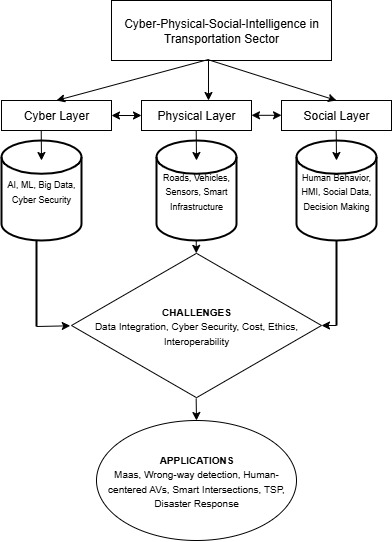
The number of fatalities due to human error or mistakes has increased all around the world, including the United States, over the past decades. According to NHTSA, over 42,000 deaths have been recorded all over the United States in 2022, and 90% of which was due to human error or mistakes. Although there was a significant advancement in transportation technologies, the number of crashes has not decreased over the years. The need for integrating new emerging technologies with the physical and social layers is necessary to consider, as human feedback and interaction over the technologies can reduce crashes and improve mobility. Studies show that Cyber-Physical-Social-Intelligent technologies like Vehicle-to-Everything (V2X) communication can reduce traffic fatalities by up to 80%, while human-centered design in automation can significantly improve compliance and lower risky behaviors. Despite their growing importance, there is a lack of proper review to integrate these machine-based autonomous technologies with human feedback input, along with the implementation challenges. This paper provides a comprehensive literature review of CPSI applications in transportation sectors, exploring theoretical models, the potential scopes, and the immense possibilities of integration of CPS-based technologies in the current transportation system in a simple, easy, and fluent way. Real-world applications of these technologies have also been discussed for the smart city framework, wrong-way driving detection, human-machine interaction, and other aspects, along with their potential benefits. Despite these advancements, several technical and institutional challenges, like data security, data management, computational capability, and financial restraints, can impede the widespread deployment of CPSS. By addressing these challenges, this review presents the key gaps in the implementation challenges of CPSI and proposes a roadmap for future development. This research will create scope for future researchers to study this growing field as well as support policymakers, engineers, and researchers in planning and designing transportation systems that are not only intelligent but also adaptive, human-centered, inclusive, and safer for all users, contributing to long-term sustainable goals like vision zero initiatives.
Downloads
Downloads
Published
Issue
Section
Categories
License

This work is licensed under a Creative Commons Attribution 4.0 International License.
Authors retain copyright to their published work and retain full publishing rights without restriction. Articles are published under the Creative Commons Attribution 4.0 International License (CC BY 4.0), which permits sharing and adaptation for any lawful purpose provided that appropriate credit is given to the authors and the original publication is cited.
Authors grant JCPSI and the Association of Global Intelligent Science and Technology (AGIST) a non-exclusive right of first publication and the right to identify JCPSI as the original publisher of record.
Authors may deposit and make publicly available the submitted version, accepted manuscript, and published version of record in an institutional repository, disciplinary repository, funder repository, personal website, or other repository of their choice without embargo, provided that the published article is cited and the journal version of record is linked when available.
How to Cite